Saturday, October 29

Until the Nation Pays Homage


On this day in 1907, the entire nation of the Netherlands celebrated the seventieth birthday of Abraham Kuyper. A national proclamation recognized that "The history of the Netherlands, in Church, in State, in Society, in Press, in School, and in the Sciences the last forty years, cannot be written without the mention of his name on almost every page, for during this period the biography of Dr. Kuyper is to a considerable extent the history of the Netherlands."

The boy who was born in 1837 was at first thought to be dull, but by the time he was twelve he had entered the Gymnasium. Years later he would graduate with highest possible honors from Leyden University.  In short order he earned his masters and doctoral degrees in theology before serving as minister at Breesd and Utrecht.

The brilliant and articulate champion of Biblical faithfulness was called to serve in the city of Amsterdam in 1870. At the time, the religious life of the nation had dramatically declined. The church was cold and formal. There was no Bible curriculum in the schools and the Bible had no real influence in the life of the nation. Kuyper set out to change all of this in a flurry of activity.

In 1872, Kuyper founded the daily newspaper, De Standard.  Shortly afterward he also founded De Heraut, a weekly devotional magazine. He continued as editor of both newspapers for over forty-five years—and both became very influential in spreading the winsome message of a consistent Christian worldview.

Two years later, in 1874, Kuyper was elected to the lower house of Parliament as the leader of the Anti-Revolutionary Party—and he served there until 1877. Three years later he founded the Free University of Amsterdam, which asserted that the Bible was the foundation of every area of knowledge.

Following a stunning victory at the polls, Kuyper was summoned by Queen Wilhelmena to form a cabinet and become Prime Minister of the nation in 1902—a position he held for three years. A number of politicians were dissatisfied with Kuyper’s leadership because he refused to separate his theological and political views separate. To him, they were identical interests since Christ was king in every arena of human life. He believed that Christ rules not merely by the tradition of what He once was, spoke, did, and endured, but by a living power which even now, seated as He is at the right hand of God, He exercises over lands, nations, generations, families, and individuals.

Kuyper was undoubtedly a man of tremendous versatility—he was a noted linguist, theologian, university professor, politician, statesman, philosopher, scientist, publisher, author, journalist, and philanthropist. But amazingly, in spite of his many accomplishments and his tremendous urgency to redeem the time, Kuyper was also a man of the people.

In 1897, at the 25th anniversary of his establishment of De Standaard, Kuyper described the ruling passion of his life: "That in spite of all worldly opposition, God's holy ordinances shall be established again in the home, in the school, and in the State for the good of the people; to carve as it were into the conscience of the nation the ordinances of the Lord, to which Bible and Creation bear witness, until the nation pays homage again to God."

Friday, October 28

The Battle Hymn of the Reformation


A mighty fortress is our God, a bulwark never failing;

Our helper He, amid the flood of mortal ills prevailing:
For still our ancient foe doth seek to work us woe;

His craft and power are great, and, armed with cruel hate,
On earth is not his equal.

Did we in our own strength confide, our striving would be losing;

Were not the right Man on our side, the Man of God’s own choosing:

Dost ask who that may be? Christ Jesus, it is He;

Lord Sabaoth, His Name, from age to age the same,

And He must win the battle.

And though this world, with devils filled, should threaten to undo us,

We will not fear, for God hath willed His truth to triumph through us:

The Prince of Darkness grim, we tremble not for him;
His rage we can endure, for lo, his doom is sure,

One little word shall fell him.

That word above all earthly powers, no thanks to them, abideth;

The Spirit and the gifts are ours through Him Who with us sideth:

Let goods and kindred go, this mortal life also;

The body they may kill: God’s truth abideth still,

His kingdom is forever.

Wednesday, October 26

The Fundamental Orders

On this day in 1633, the little Puritan and Pilgrim congregation at Newton, in the fledgling Massachusetts Bay Colony—since renamed Cambridge—held a day of fasting and prayer at the end of which they chose Thomas Hooker as their pastor. Hooker had only arrived in the colony the previous month, but his zeal for the doctrines of grace and his pastoral qualifications had been amply demonstrated in years of difficult service in England.

Born in 1586 in Leicestershire, Hooker studied theology at Cambridge University and became a popular lecturer and an able assistant to the rector of the parish church in Chalmsford. Though Hooker accepted the most of the doctrines of the Church of England, he did not believe its liturgy or ecclesiology was Biblical—in other words, he was a dissenter when it came to worship and church government. Accordingly, in 1630 he came under the discipline of Archbishop Laud—a fierce persecutor of nonconformity. When he was summoned to appear before the dreaded High Commission, Hooker fled to Holland where he preached to exiled Puritans in both Delft and Rotterdam. He became an assistant to the renowned theologian, William Ames and wrote a pamphlet entitled, A Fresh Suit against Human Ceremonies in God's Worship.

In 1633, Hooker, along with the Puritan preachers John Cotton and Samuel Stone, fled to America aboard the Griffen. When the three prominent men arrived in Boston in September, several Puritans quipped that they now had "Cotton for their clothing, Hooker for their fishing, and Stone for their building." It was not surprising that the Newton congregation so quickly chose Hooker as their pastor.

In Massachusetts, however, Hooker began to question the form of government established by the Massachusetts Bay Colony. He questioned the validity of a church covenant forming the basis for a civil government. Hooker did not believe that participation in the government should be limited to church members. Rather, he asserted that all civil government should be based on voluntary submission to some kind of civil covenant, just as the churches were established on a covenant in spiritual things. The foundation of government, he thought, lay in the free choice of the people, who were to choose public officials according to God's will and law. Hooker's views on government were much more democratic than those espoused by the leaders of the Massachusetts Colony.

Because of these differences, Hooker peacefully left Massachusetts with a number of members from his Newton congregation and established the town of Hartford in Connecticut. In 1638, three of the Connecticut towns met to form a government. In a sermon preached to the General Court at that time, Hooker maintained that the foundation of government authority is "laid in the free consent of the people, that the choice of public magistrates belongs unto the people by God's own allowance." The text from which Mr. Hooker derived his sermon was Deuteronomy 1:13, "Take you wise men, and understanding, and known among your tribes, and I will make them rulers over you."
The resulting government which was formed, The Fundamental Orders of Connecticut, was the first written Constitution in America.

Tuesday, October 25

St. Crispin’s Day


Two legendary battles, both immortalized in English literature, took place on this day, the Feast of St. Crispin.  

The first, in 1415, was the great Battle of Agincourt.  England’s King Henry V and his long bow archers defeated the overwhelming force of French Army in the fields of northern Normandy.  Vastly outnumbered, weary from a long and difficult campaign, hopelessly trapped against the coast, with no possible retreat, Harry deployed the heretofore untested technology of the long bow to stunning effect.

The feat inspired Shakespeare’s famous monologue in his epic drama, Henry V:

If we are marked to die, we are enough to do our country loss; 
And if to live, the fewer the men, the greater share of honor.
God’s will, I pray thee, wish not one man more.
This story shall the good man teach his son,
And Crispin Crispian shall ne’er go by 
From this day to the ending of the world but we in it shall be remembered.
We few, we happy few, we band of brothers.
For he today that sheds his blood with me shall be my brother; 
Be he ne’er so vile, this day shall gentle his condition.
And gentlemen in England now abed shall think themselves accursed they were not here,
And hold their manhoods cheap whiles any speaks that fought with us
On St. Crispin’s Day.

The second battle, in 1854, was the Charge of the Light Brigade at the climax of Battle of Balaklava during the Crimean War. The battle which has been long regarded as one of the most famous military blunders in history, pitted an allied Anglo-French army and a Russian force commanded by General Liprandi.

The Light Brigade consisted of five regiments totaling 661 men.  The men were ordered to attack a well-entrenched Russian force—it was a certain slaughter but due to confused communications and conflict within the officer corps, the men advanced into a withering line of fire.  The charge lasted less than twenty minutes.  When the brigade was mustered afterwards, there were only 195 mounted men left.

Though the maneuver seemed to be a complete disaster, the men actually achieved their objective.  General Liprandi was deeply impressed by the unflinching composure of the British horsemen. And, the moral effect on the Russians of the discipline, courage, and resolve of the Light Brigade was immense. For the rest of the war, the Russian cavalry refused direct, pitched combat with the British, even when vastly superior in numbers.

Long afterwards, the fact that a single, under-strength brigade of light cavalry had captured a battery of guns and driven off a far larger body of Russian horses was the admiration of Europe.

This battle also inspired a work of great literature, The Charge of the Light Brigade, by Alfred Lord Tennyson:

Half a league half a league,
Half a league onward,
All in the valley of Death
Rode the six hundred:
'Forward, the Light Brigade!
Charge for the guns' he said:
Into the valley of Death
Rode the six hundred.

'Forward, the Light Brigade!'
Was there a man dismay'd ?
Not tho' the soldier knew
Some one had blunder'd:
Theirs not to make reply,
Theirs not to reason why,
Theirs but to do and die,
Into the valley of Death
Rode the six hundred.

Cannon to right of them,
Cannon to left of them,
Cannon in front of them
Volley'd and thunder'd;
Storm'd at with shot and shell,
Boldly they rode and well,
Into the jaws of Death,
Into the mouth of Hell
Rode the six hundred.

Flash'd all their sabres bare,
Flash'd as they turn'd in air
Sabring the gunners there,
Charging an army while
All the world wonder'd:
Plunged in the battery-smoke
Right thro' the line they broke;
Cossack and Russian
Reel'd from the sabre-stroke,
Shatter'd and sunder'd.
Then they rode back, but not
Not the six hundred.

Cannon to right of them,
Cannon to left of them,
Cannon behind them
Volley'd and thunder'd;
Storm'd at with shot and shell,
While horse and hero fell,
They that had fought so well
Came thro' the jaws of Death,
Back from the mouth of Hell,
All that was left of them,
Left of six hundred.

When can their glory fade?
O the wild charge they made!
All the world wonder'd.
Honour the charge they made!
Honour the Light Brigade,
Noble six hundred!

Monday, October 24

All Heaven and Earth


‎"When you sell a man a book you don’t sell him just twelve ounces of paper and ink and glue—you sell him a whole new life. Love and friendship and humor and ships at sea by night—there’s all heaven and earth in a book, a real book I mean." Christopher Morley

Sunday, October 23

God's Victory


Three days after French troops under the command of Jean Baptiste de Vimeur, Comte de Rochambeau, and the Marquis de Lafayette helped George Washington's ragged forces defeat the British Army, the men celebrated the formal surrender of Lord Cornwallis.  The British band played the popular song "The World Turned Upside Down" as they stacked up their arms. 

The last major fighting of the American War for Independence had somehow ended in a resounding American victory.  Washington and the others could not help but recognize God's hand in the victory. Indeed, it was when the American forces were at their weakest, that victory had finally come.  Accordingly, Washington issued orders to the army that "Divine service is to be performed in the several brigades and divisions. The commander-in-chief recommends that the troops not on duty should universally attend with that seriousness of deportment and gratitude of heart which the recognition of such reiterated and astonishing interpositions of Providence demand of us."

That celebration of God's good providence occurred on this day in 1781.

Saturday, October 22

Texas: A Whole Other Country

On this day in 1836, former Tennessee congressman, senator, and governor, Sam Houston was inaugurated as the first constitutionally elected president of the Republic of Texas.

Friday, October 21

Let There Be Light


On this day in 1878, Thomas A. Edison invented a practical incandescent lamp in his laboratory at Menlo Park, New Jersey.  "The longer it burned," he said, "the more fascinated we were…there was no sleep for any of us for forty hours."

Thursday, October 20

On the Nightstand


Johnson's Latest

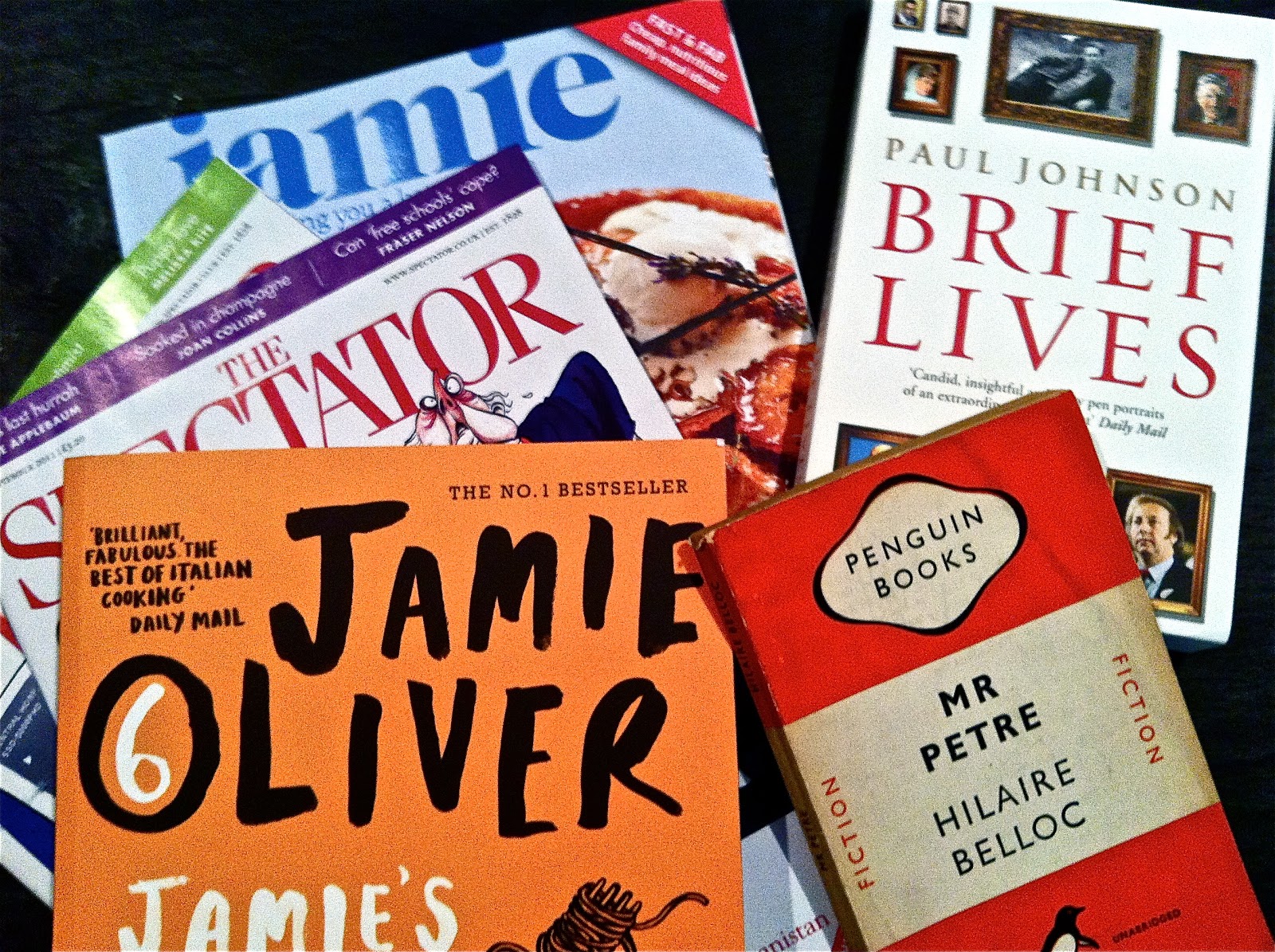
In 2003, when Paul Johnson published his massive and magisterial Art: A New History, he announced it would be his last book.  Since then, he has published by my count, eleven new books.  Thanks be to God.  The new books have mostly been shorter biographies--in his Brief Lives series.  This morning I finished the most recent of these: Socrates.  Since I'm lecturing on the world of Antiquity this year, this new contribution from my favorite living historian is most welcome.  And as always, Johnson is witty, insightful, and provocative.  This is the application of the old discipline, Moral Philosophy, at its best. I am so glad that Johnson just couldn't help himself from writing--long after he'd decided to stop writing! We're all the better for it.